
Philipp Beer Selected for the 2026 Google PhD Fellowship!
We’re thrilled to announce that Philipp Beer, PhD researcher at CySec under the supervision of Marco Squarcina, has been selected as a recipient of the 2026 Google PhD Fellowship Program with support from Google.org!
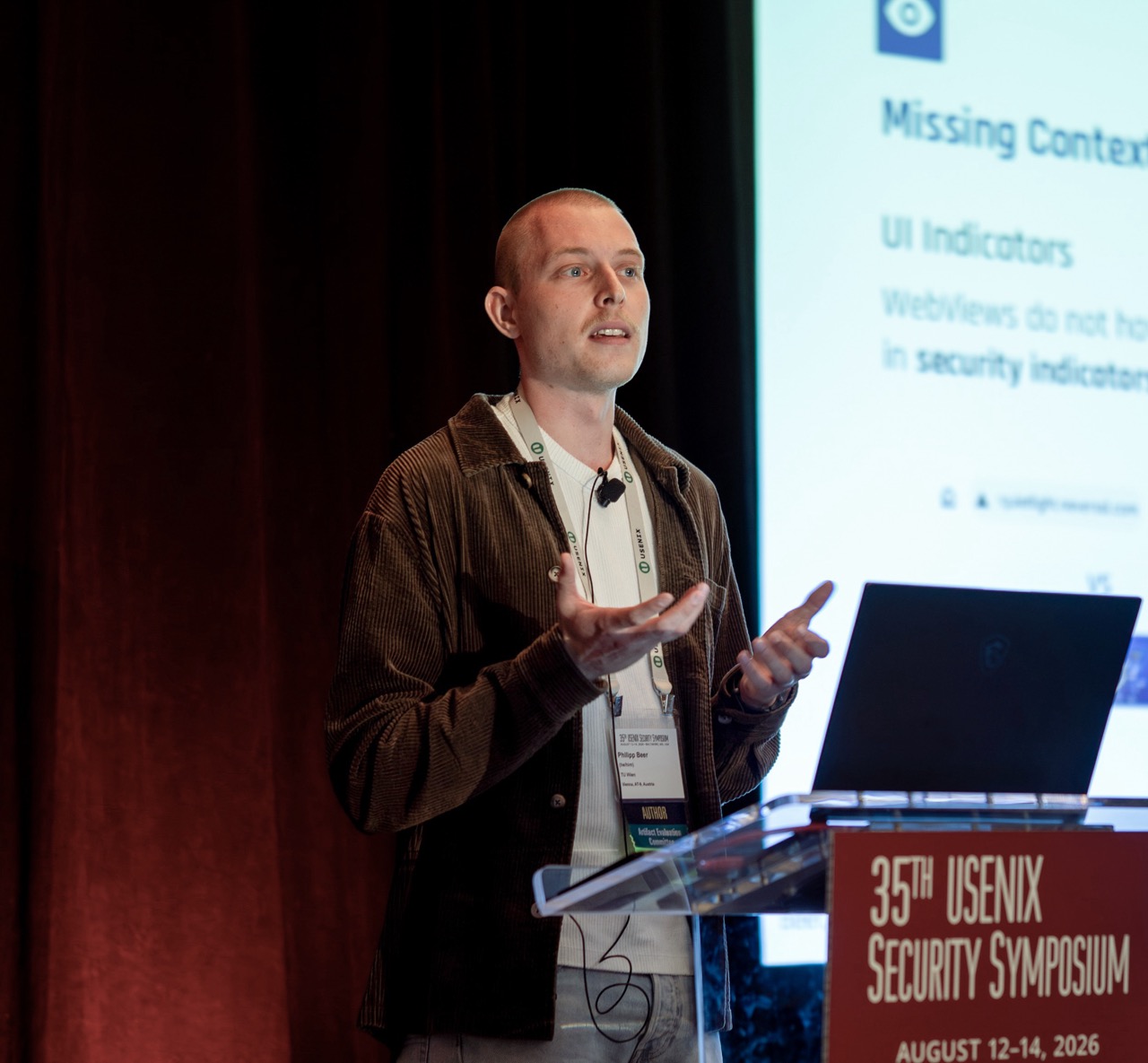
Foto: © Marco Squarcina
The Google PhD Fellowships recognise outstanding graduate students conducting exceptional and innovative research in computer science and related fields. Philipp is among 148 new PhD fellows across 38 countries selected this year through $13 million in funding from Google.org. Beyond direct financial support for doctoral studies, which gives researchers the freedom to pursue high-risk, high-reward foundational questions, every fellow is welcomed into a lifelong global peer network.
In his research, Philipp focuses on security and privacy issues that arise in mobile and Web ecosystems, with a particular interest in mobile applications, browsers and in-app browsing, and the security of mobile user interfaces. He carries out this work at CySec under the supervision of Marco Squarcina.
Since 2009, the Google PhD Fellowship Program has supported more than 1,100 graduate students worldwide. Over the past 17 years, alumni of the program have gone on to become tenured professors, startup founders, open-source pioneers, and research leaders helping shape the future of technology.
Watch Philipp talk about his research on our YouTube channel.
Congratulations, Philipp, on this outstanding achievement, and congratulations to Marco on supervising such an excellent researcher!
About Philipp: Philipp Beer is a doctoral researcher at CySec, based in the Research Unit for Security and Privacy at TU Wien Informatics, where he is supervised by Marco Squarcina. His research investigates security and privacy issues that arise in mobile and Web ecosystems, with a particular interest in mobile applications, browsers and in-app browsing, and the security of mobile user interfaces. Before starting his PhD, he completed his MSc in Software Engineering and Internet Computing and his BSc in Software and Information Engineering at TU Wien.
A central theme of his work is taking a holistic view of the interaction between web content and mobile apps, rather than studying either in isolation. His research spans the discovery of new attack techniques, their systematic evaluation at scale, and the study of their practical impact on users. To this end, he combines vulnerability discovery and systems analysis with large-scale empirical measurements and human-centred studies.
His work has been published at leading computer security venues, including the IEEE Symposium on Security and Privacy and the USENIX Security Symposium, and has led to several CVEs as well as changes to widely deployed systems such as Android, Chrome, and Firefox.
More about Philipp: beerphilipp.com