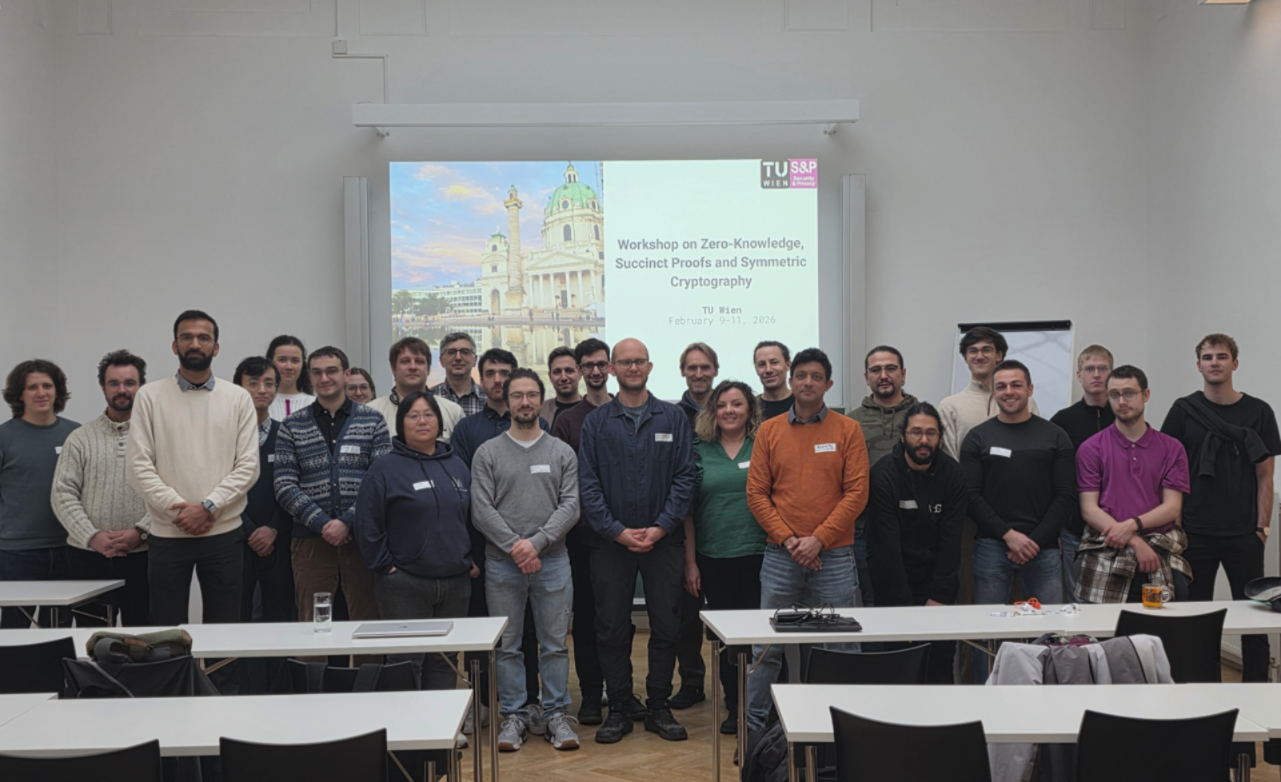
ZKSC 2026 Workshop
ZKSC 2026 – the Workshop on Zero-Knowledge, Succinct Proofs and Symmetric Cryptography – successfully took place on February 9–11, 2026. Organized by Elena Andreeva and Georg Fuchsbauer, the event brought together researchers from zero-knowledge and symmetric cryptography, two communities whose interaction is becoming increasingly essential for modern privacy-preserving systems. The workshop formed part of the activities of the Cybersecurity Center TU Wien and the FWF-funded SPyCoDe project, with additional support provided by the Ethereum Foundation.
The workshop featured a diverse and high-level program of talks covering foundational advances, practical challenges, and emerging directions at the intersection of zero-knowledge and symmetric cryptography:
- Christian Rechberger: On Zero-Knowledge Proofs and Symmetric Crytography,
- Ivan Visconti: A Few Stops in the Zero-Knowledge Journey,
- Léo Perrin: When POlynomial System SOlving became a threat for symmetric primitives,
- Ziyi Guan: On the Security of Succinct Arguments from Probabilistic Proofs,
- Arnab Roy: When Polynomials Iterate: Structure and Security in Symmetric Cryptography,
- Abhishek Jain: IVC without Random Oracles,
- Dmitry Khovratovich: Succinct Proofs in the Core Ethereum Protocol,
- Stefano Trevisani: New Modes on the Block: Security and Efficiency of Novel AO Compression Modes,
- Lorenzo Grassi: Greek and Roman Gods in Symmetric-Key Crypto,
- Justin Thaler (remote talk): Lessons from Jolt: When Do We Need SNARK-Friendly Primitives?,
- Dmitry Khovratovich: Panel on Poseidon,
- Michele Orrù (remote talk): A Fiat–Shamir Transformation From Duplex Sponges,
- Markus Schofnegger: Implementation Characteristics of Hash Functions in Modern Proof Systems,
- Ngoc Khanh Nguyen: Recent Progress on Lattice-based Zero-Knowledge Proofs,
- Georg Fuchsbauer: Plonk Without Random Oracles.
The program also included dedicated breakout sessions that encouraged focused discussions and in-depth exchanges on emerging research questions.