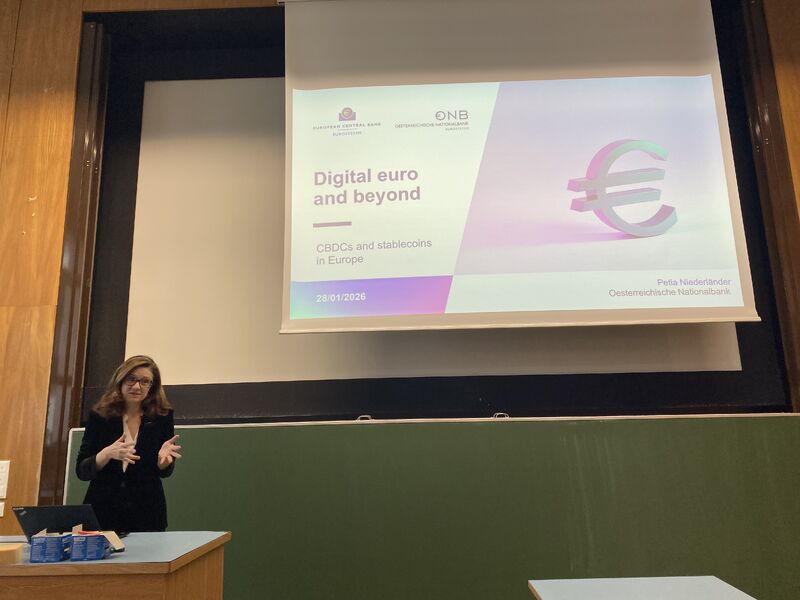
Digital Euro and Beyond - CBDCs and Stablecoins in Europe
Talk by Petia Niederländer
Bio: Petia Niederlaender is the Director for Payments, Risk Monitoring and Financial Literacy of Austrian National Bank (Oesterreichische Nationalbank) and a member of ECB’s Market Infrastructure Board. Petia jointed payments and banking more than 25 years ago. Prior to her role in the Austrian National Bank, she had several management positions in one of the biggest Retail Banks in Austria, served on the board of EBA Clearing as well as national and international payments bodies.
Background: What is the digital euro and why does it matter?
The digital euro is a project by the European Central Bank to create a public digital version of the euro. It is being developed in response to the rapid decline in cash use and the growing dominance of private digital payment systems across Europe. Today, most electronic payments rely on non-European providers, which has raised concerns about Europe’s financial independence and long-term control over its payment infrastructure.
Another driver behind the digital euro is the rise of stablecoins—privately issued digital currencies that are often linked to foreign currencies. Policymakers worry that widespread use of such instruments could further weaken the role of public money and increase dependence on private or foreign issuers.
Supporters argue that the digital euro could offer a public alternative to private payment solutions. It would be designed as a basic payment infrastructure, allowing banks and payment companies to build additional services on top of it. The European Central Bank has also highlighted stronger privacy protections and lower costs for consumers and merchants as potential advantages, as well as improved access to digital payments for people who are currently underserved.
However, experience from other countries suggests that public digital currencies are not automatically adopted. In regions with already efficient digital payment systems, people may see little reason to switch unless the new system offers clear benefits in terms of convenience, cost, or trust.
One of the most debated aspects of the digital euro is the proposed limit on how much individuals could hold. Current plans suggest relatively low caps, which critics say would prevent the digital euro from serving as a meaningful store of value. Unlike cash, bank deposits, or stablecoins, which have no formal holding limits, a capped digital euro may be less attractive to users.
The European Central Bank argues that limits are needed to protect financial stability, as an unlimited digital euro could make it easier for people to move money out of banks during a crisis. Critics counter that digital bank runs are already possible and that a public digital euro could be safer than private alternatives and easier for authorities to manage in times of stress.
More broadly, the debate over the digital euro has reopened questions about the structure of Europe’s banking system and the balance between public and private money in a digital economy. Whether the digital euro will succeed will largely depend on its final design and whether it offers enough value to persuade Europeans to use it in everyday life.