AI-Powered Victory at the A2RL 2026 Drone Championship
A2RL (Abu Dhabi Autonomous Drone Race League) is a pioneering extreme racing series dedicated to advancing the frontiers of autonomous technology. Initiated by ASPIRE and realized through the collaborative efforts of engineers, scientists, and programmers, it functions both as a high-performance competition and as a global platform for innovation in AI-driven mobility. Each year, multidisciplinary teams from leading academic and technological institutions worldwide compete to design and deploy the fastest, most robust, and most capable autonomous racing systems.
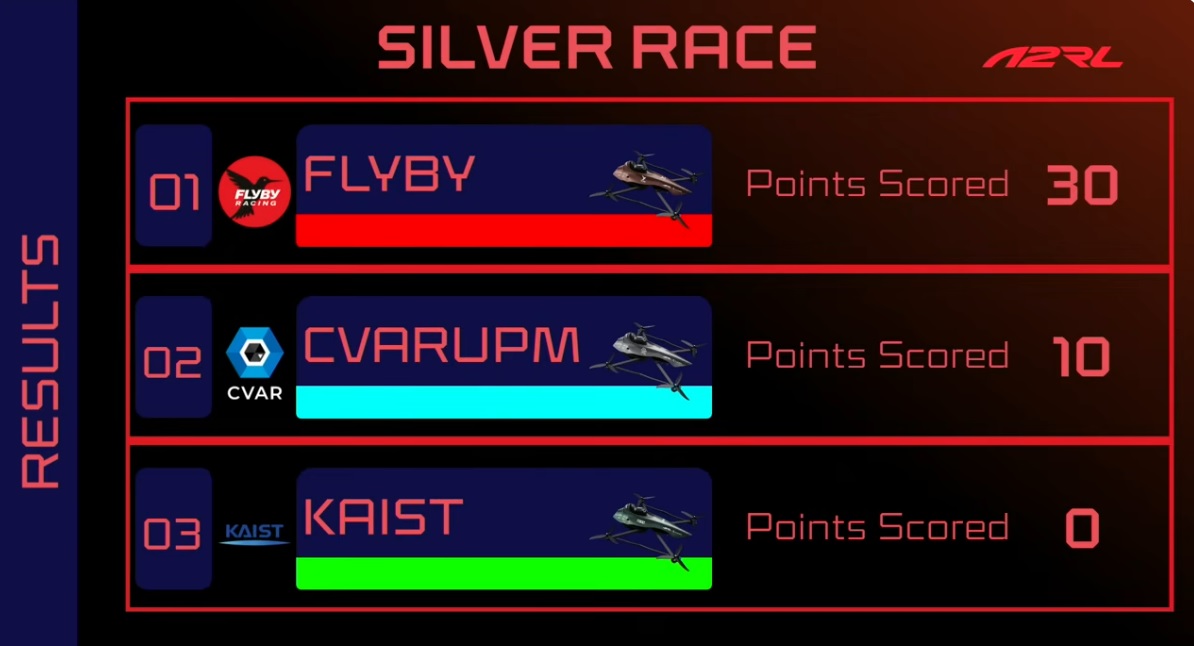
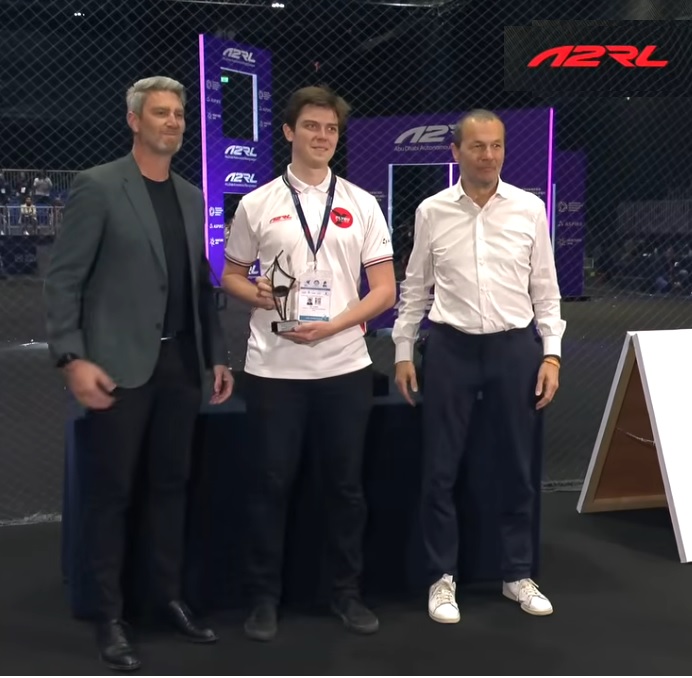
Team FlyBy won the Silver Group at A2RL 2026. The core team consists of Joel Klimont (PhD student with Prof. Radu Grosu, Cyber-Physical Systems, TU Wien), Alexander Lampalzer (Master’s student, TU Wien), and Jakob Buchsteiner (Master’s student, TU Wien). They were supported by Konstantin Lampalzer (Master’s student, TU Wien), Thisas Ranhiru (Bachelor’s student, RIT Dubai), and Akos Papp (student at HTL Wiener Neustadt and member of the robotics club robo4you).
A2RL is known for its exceptionally strict and fair rules: each team is provided with exactly the same drone by the organizers, eliminating any hardware advantage. As a result, success depends entirely on software performance — specifically on how effectively perception, state estimation, and control algorithms interact under real-world racing conditions. The competition therefore serves as a rigorous benchmark for algorithmic excellence and system integration.
The FlyBy system is built on a highly efficient autonomous control architecture that relies solely on a single camera and motion sensors. With this minimal sensor configuration, the drone must estimate its position and velocity and detect race gates in real time while operating at high speeds. After months of development and refinement, the system achieved peak speeds of up to 20 meters per second.
Shortly before the January 2026 final, the team made a bold strategic decision: rather than relying exclusively on classical control methods, they integrated reinforcement learning into their control framework. This AI-driven approach enabled the drone to learn optimal racing strategies autonomously. The shift proved decisive — reinforcement learning delivered not only higher speeds but also increased stability, particularly in demanding multi-drone race scenarios.
The full competition video can be viewed on YouTube