
Security Strategies for a Connected Future
TU Wien alumni club serves as a platform for exchange, offering information on current developments at the university and fostering networking among its members. Through its activities and resources, the association promotes a lifelong connection between TU Wien and its alumni, in line with the graduation pledge to “remain connected to TU Wien.”
The March 2025 issue (No. 58) of the TU Wien Alumni Magazine is dedicated to the theme “Security Strategies for a Connected Future.” In this thematic edition, members of the Cybersecurity Center (CySec) contribute five articles that showcase TU Wien’s strengths in cybersecurity research, education, and societal impact.
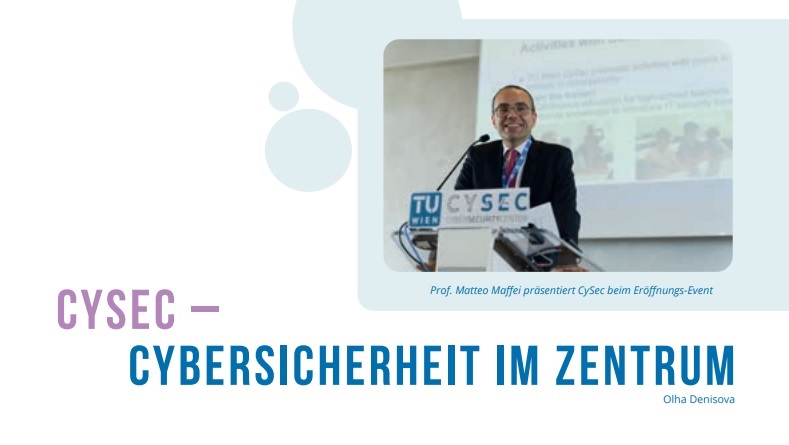
In the article “CySec – Cybersecurity at the Center,” Olha Denisova presents CySec as TU Wien’s interdisciplinary response to the rapidly escalating threats of cybercrime, data breaches, fraud, and system manipulation, whose global costs are projected to reach USD 10 trillion annually by 2026. Founded in 2023 under the leadership of Matteo Maffei and Tanja Zseby, CySec brings together 23 faculty members and around 150 researchers from computer science, electrical engineering, physics, statistics, architecture, and law. The article highlights CySec’s core research outputs in secure communication protocols, software verification, and vulnerability analysis, as well as its strong international visibility through leading conferences, public events, and collaborations with top universities and technology companies. Beyond research excellence, CySec’s societal impact lies in educating the next generation of cybersecurity experts and actively promoting diversity and inclusion in the field.
Marco Squarcina examines Capture the Flag (CTF) competitions as a powerful training ground for cybersecurity professionals and a cornerstone of CySec’s educational mission. The article traces TU Wien’s more than 20-year engagement in ethical hacking, beginning with the founding of the CTF team We_0wn_Y0u (W0Y) and extending to major initiatives such as the Austria Cyber Security Challenge and the European Cyber Security Challenge. It demonstrates how hands-on, gamified learning equips students with technical expertise, creativity, and teamwork skills essential for modern cyber defense, while contributing to national and European cybersecurity talent pipelines.
The article, authored by Georgia Avarikioti from the TU Wien Blockchain Hub, addresses two key challenges limiting the widespread adoption of blockchain technologies: scalability and interoperability. It explains how CySec-affiliated researchers develop layer-2 protocols and cross-chain solutions that enable secure and efficient transactions without compromising decentralization or trust. These innovations support applications ranging from decentralized finance to secure digital contracts and Web3 infrastructures, highlighting the broader societal impact of building fairer and more trustworthy digital economic systems.
Elena Andreeva analyzes how cryptographic standards shape real-world security, privacy, and trust, and why flawed standardization decisions can have far-reaching consequences. Led by Andreeva, the Symmetric Cryptography Group at TU Wien contributes both to the design of novel cryptographic algorithms and to the critical evaluation of existing standards. The article discusses successful standards such as AES, problematic cases marked by insufficient transparency, and standards rendered obsolete by advances in cryptanalysis, underscoring CySec’s role in advancing robust, future-proof security technologies.

The final contribution, “Lost Between Reality and Fiction: Authenticity and Privacy in the Age of AI,” by Dominique Schröder, addresses one of the most pressing challenges of the digital era: distinguishing authentic information from manipulated or AI-generated content. Against the backdrop of deepfakes, automated text generation, and large-scale disinformation, the article explores how modern IT security techniques — such as digital signatures, cryptographic authentication, and fully homomorphic encryption — can ensure authenticity while preserving privacy. By presenting practical scenarios from media verification to encrypted data processing in healthcare and business, the article highlights concrete technological approaches to counter disinformation and strengthen trust in digital media and democratic processes.